Guide
What size crate does my dog need to fly?
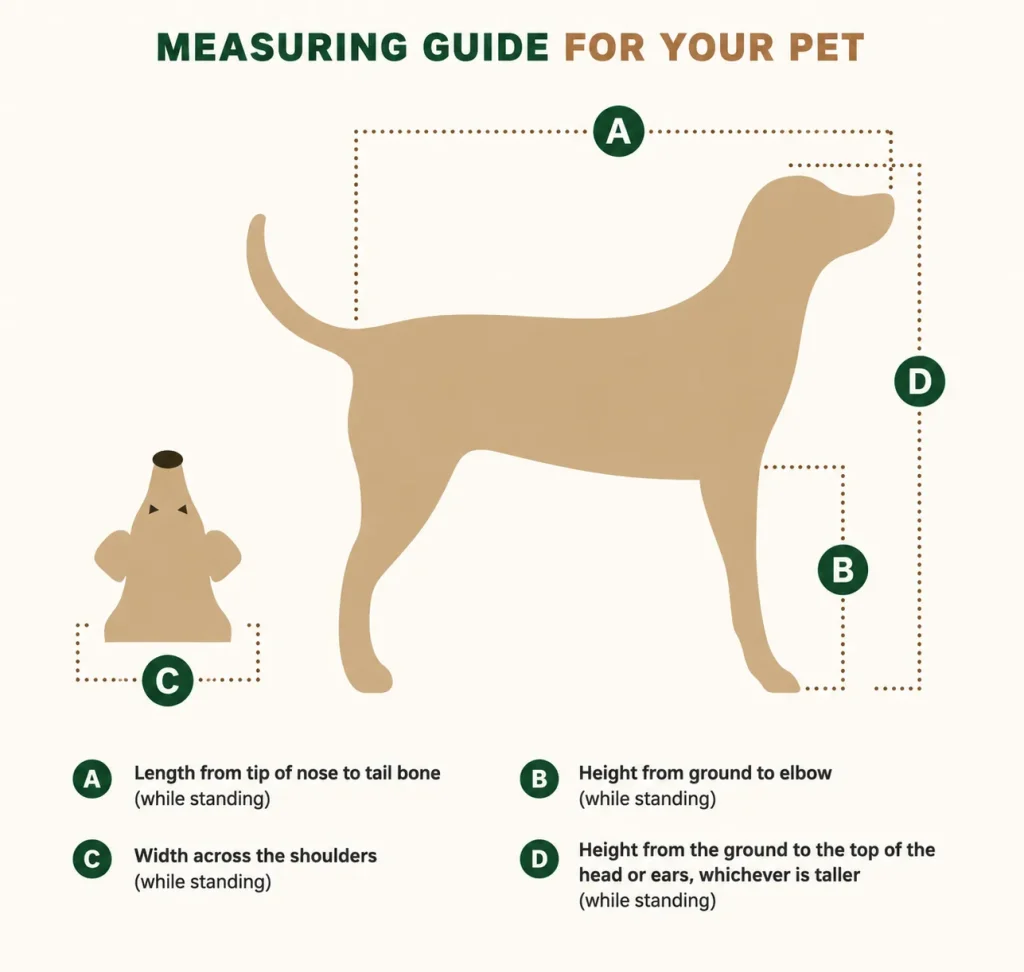
The honest answer is that there is no such thing as a “medium” or “large” flight crate. Airlines size crates from your dog’s own measurements, not from a label on a box, and a crate that is even slightly too small can be refused at check-in. Here is how the sizing actually works.
The four measurements
Measure your dog standing naturally on a flat floor, in centimetres:
A. Nose to root of tail. From the tip of the nose to where the tail meets the body, not to the end of the tail.
B. Ground to elbow. From the floor to the elbow joint of the front leg.
C. Width across the shoulders. The widest point of your dog, measured straight across.
D. Standing height. From the floor to the top of the head, or to the tips of the ears, whichever is higher.
Our measuring guide has a diagram showing exactly where each one is taken.
What the airline does with them
The rule, set by IATA’s Live Animals Regulations, is that your dog must be able to stand at full natural height, turn around and lie down normally inside the crate. In practice the crate is sized roughly like this:
- Length: A plus half of B
- Width: at least twice C
- Height: D plus clearance for bedding and headroom
So a Labrador measuring 90cm nose to tail with a 30cm elbow height needs a crate around 105cm long inside, before anything else is considered. This is why guessing from breed alone goes wrong: two Labradors can differ by a crate size.
Snub-nosed breeds are a special case
Bulldogs, pugs, boxers, Persian cats and other brachycephalic breeds struggle more with heat and airflow, so most airlines require a crate one size larger with extra ventilation, and some will not carry these breeds at all in warmer months. If your dog is snub-nosed, tell your airline early and tell your crate builder too.
The mistakes we see most
Measuring to the tip of the tail. That adds 20 to 40cm and buys a crate your dog rattles around in, which is its own welfare problem in handling and turbulence.
Rounding down to save money. Check-in staff measure dogs against crates every day. A tight crate is the most common reason a pet is refused at the airport.
Trusting a “one size fits most” plastic kennel. Fixed sizes fit the dogs they fit. If yours is between sizes, long-backed, tall-eared or heavy-coated, a crate built to their measurements removes the gamble.
The easy way
Send us the four measurements and your travel date, and we do the rest: the IATA formula, your airline’s own rules, and a crate built to the result in our Dorset workshop. We sense-check every set of numbers against the breed and weight, and if something looks unusual we ring you before we cut anything.
Get a crate quote or start with the measuring guide.