Guide
Are wooden pet crates allowed on flights? The rules, in plain English
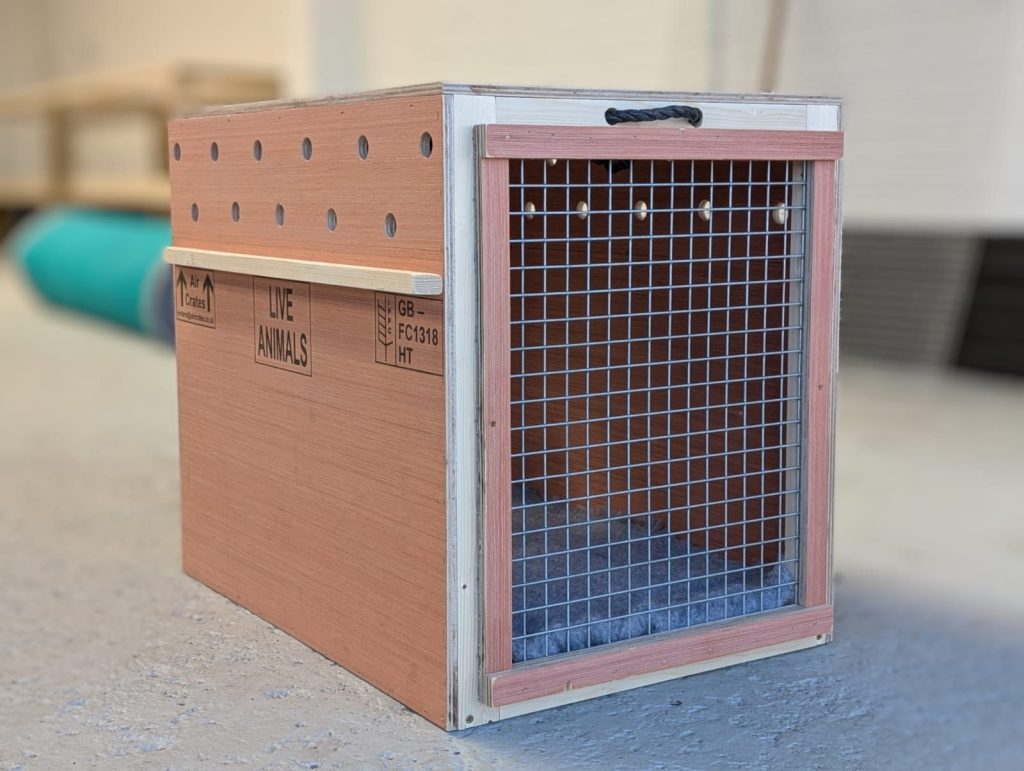
Short answer: yes. Wooden crates are flown every day, and for many dogs they are the better option. What matters is not the material but whether the crate complies with IATA’s Live Animals Regulations and your airline’s own rules. Here is what that means without the jargon.
First, a myth worth clearing up
You will see crates everywhere advertised as “IATA approved”. Strictly speaking, there is no such approval. IATA publishes the Live Animals Regulations (LAR), and Container Requirement 1 (CR1) within them sets the standard that dog and cat crates must meet. Nobody stamps individual crates. What counts is whether a crate genuinely complies with CR1, and whether your airline’s staff agree that it does on the day.
What Container Requirement 1 actually asks for
- Rigid construction that holds its shape under handling. Wood does this naturally; it is why wooden crates are the norm for giant breeds and heavy dogs that flex a plastic kennel.
- Room to behave naturally. The animal must be able to stand at full height, turn around and lie down normally. See our guide to measuring your dog.
- Ventilation on multiple sides, correctly sized and positioned.
- A secure, escape-proof door** with metal hardware the animal cannot work loose.
- A leak-proof base with absorbent bedding.
- Food and water access that can be refilled from outside without opening the door.
- Live Animals and This Way Up markings** so every handler knows what they are carrying.
Every crate we build meets these as a matter of course, along with treated timber, sound insulation and vetbed bedding over incontinence pads.
Where airlines differ
Individual carriers add rules of their own, and they change them without much notice. Common examples: no wheels, extra ventilation and a larger crate for snub-nosed breeds, specific fastening types, and limits on two animals sharing. This is why “compliant with CR1” is the start of the conversation, not the end of it. Tell us your airline and route when you enquire and we build their requirements in from the beginning, then give you the full dimensions and construction details so the airline or your shipping agent can confirm acceptance before the flight.
Wood or plastic?
A plastic kennel is fine for a dog that happens to fit one of its fixed sizes. A wooden crate earns its keep when the dog is large, heavy, anxious, between sizes or travelling a long way: rigid walls that do not flex and rattle, sound insulation against the loudest part of the journey, and a build sized to the animal rather than the mould. There is a reason freight handlers trust timber.
Get a compliant crate quote, or read more about airline requirements.